
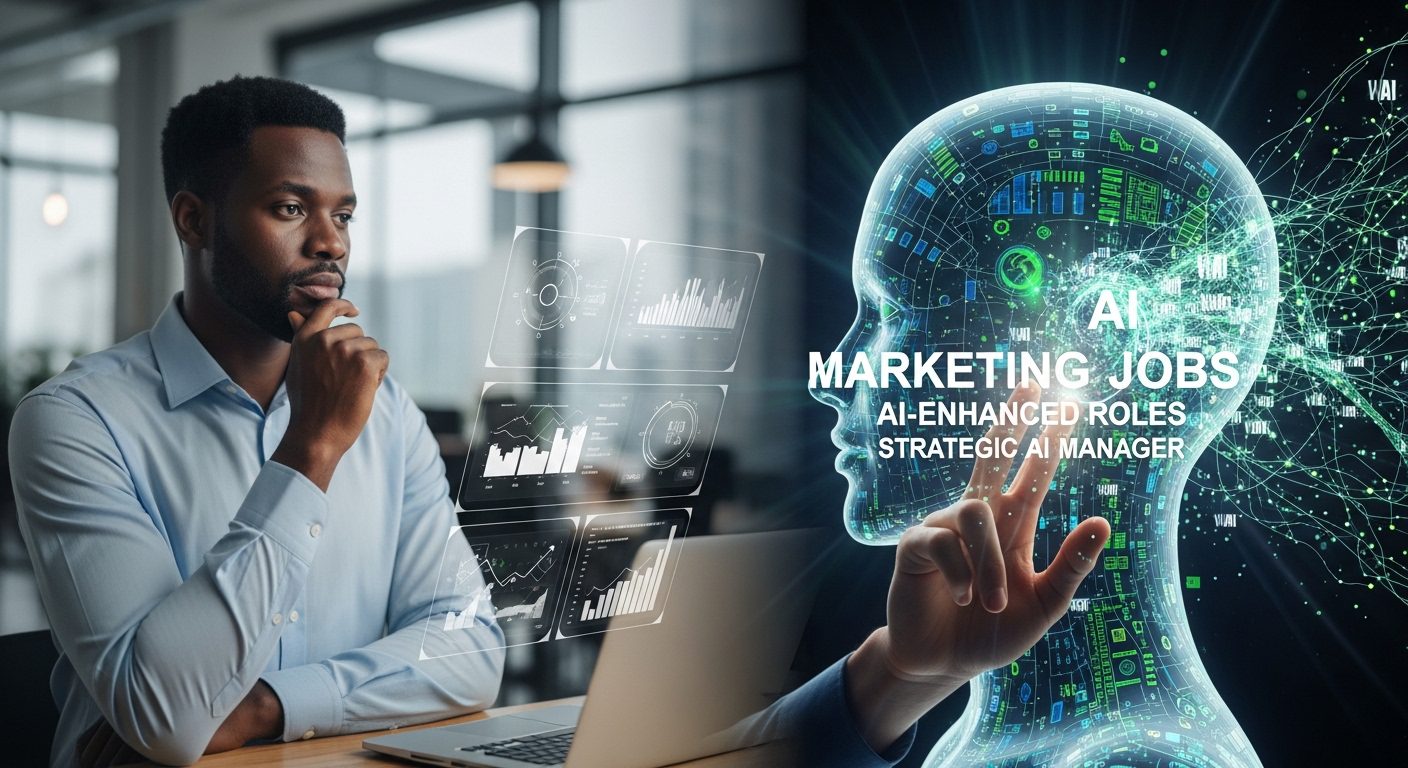
AI Is Not the First Disruption, But It May Be the Fastest
Technological disruption has always reshaped work. From the industrial revolution to computers and mobile internet, each wave changed how professionals created value. Those who adapted thrived. Those who resisted often fell behind. Artificial Intelligence represents the next major shift, and marketing is among the first industries experiencing its full impact in Nigeria.
Unlike previous technological changes, AI does not only automate physical labor. It automates cognitive tasks once considered uniquely human, including writing, analysis, design ideation, and decision support. Today, Nigerian marketers are witnessing workflows change in real time. Tasks that once required hours of manual execution are now completed in minutes using AI-powered tools.
Global and regional data confirms the scale of this transformation. The World Economic Forum’s Future of Jobs Report estimates that over 60% of workers worldwide will require new skills by 2027 as automation and AI reshape industries. At the same time, development finance institutions warn that Africa faces a widening gap between technological adoption and workforce readiness. Marketing sits directly at the center of this transition.
The Data Behind AI’s Impact on Work in Africa and Nigeria
Artificial Intelligence is not simply a technology trend; it is an economic transformation. Several global institutions provide insight into what lies ahead:
Global Economic Impact
- McKinsey Global Institute estimates that generative AI could contribute $2.6 trillion to $4.4 trillion annually to the global economy through productivity gains.
- If Africa captures just 10% of the global AI opportunity, AI could add $1.5 trillion to Africa’s GDP by 2030.
These projections depend on one critical factor: workforce capability.
Africa’s Digital Skills Challenge
Research referenced across IFC, SAP, and World Bank analyses indicates:
- 230 million jobs in Sub-Saharan Africa will require digital skills by 2030.
- More than 650 million Africans will need some form of digital training within the same period.
- Yet fewer than 11% of workers currently possess adequate digital skills readiness.
This gap represents one of the largest workforce transitions in modern history.
Nigeria’s Urgent Context
Nigeria presents both opportunity and risk.
- The ICT sector already contributes approximately 17% of Nigeria’s GDP, showing strong digital potential.
- Youth unemployment remains around 23%, highlighting structural employment challenges.
- Employers consistently report shortages of digitally skilled talent despite a large workforce.
Local business reporting shows many organizations still rely heavily on manual processes, causing companies to “spend more to achieve less” due to low technology adoption. Without rapid upskilling, AI adoption could widen inequality between digitally prepared professionals and those left behind.
How AI Is Transforming Marketing Jobs in Nigeria
Artificial Intelligence is not eliminating marketing roles. Instead, it is redefining responsibilities across nearly every specialization.
1. Content Creators
AI tools such as ChatGPT, Canva AI, Midjourney, and Jasper can now:
- Draft blog articles and social captions
- Generate advertising copy
- Produce visual concepts
- Create video outlines
Routine production is increasingly automated. The human marketer’s value shifts toward:
- Creative direction
- Brand storytelling
- Audience psychology
- Editorial judgment
Creativity becomes more strategic rather than manual.
2. Social Media Managers
AI-powered systems now handle:
- Automated posting schedules
- Customer chat responses
- Sentiment analysis across comments
- Engagement pattern detection
Chatbots on WhatsApp and Facebook can respond instantly to customer inquiries, freeing marketers from repetitive interactions. The role evolves into community strategy and brand experience management.
3. SEO and Digital Marketing Specialists
Search and advertising platforms increasingly operate on AI logic. Tools now automate:
- Keyword research
- Content optimization recommendations
- A/B testing
- Bid adjustments
- Audience targeting
Platforms like Google Performance Max and Meta Advantage already rely heavily on machine learning. Marketers must now interpret AI outputs rather than manually execute optimizations.
4. Performance Marketers
AI continuously reallocates advertising budgets toward high-performing audiences and creatives. This creates:
- Higher efficiency
- Reduced campaign waste
- Faster experimentation cycles
The marketer’s role becomes analytical oversight rather than operational control.
5. Web Developers and Designers: AI-Assisted Creation
AI coding assistants and no-code platforms now generate:
- Website layouts
- Code snippets
- Debugging suggestions
- CMS automation workflows
Developers increasingly focus on integration, customization, and user experience rather than repetitive coding tasks.
6. Data Analysts: Insight Generation at Machine Speed
AI-powered analytics tools embedded in Excel, Power BI, and analytics platforms can now:
- Clean datasets automatically
- Suggest visualizations
- Forecast trends
- Identify performance drivers
Junior analysts no longer compete on reporting speed but on interpretation and business insight.
AI Tools Already Used by Nigerian Marketers
Many Nigerian professionals are already experimenting with AI across categories:
Generative Content
ChatGPT, GPT-4, Jasper, Canva AI, Midjourney
Analytics & Data
Excel AI features, Power BI AI visuals, Google Analytics Intelligence, Python libraries
Marketing Automation
Zapier, HubSpot AI, Mailchimp automation workflows
SEO & Advertising
SurferSEO, SEMrush AI tools, Google Ads automation, Meta AI optimization
Customer Engagement
AI chatbots, WhatsApp Business integrations, AI-powered CRMs. These tools allow small teams to achieve productivity levels previously possible only for large agencies.
Local Industry Trends in Nigeria
Evidence of adoption is growing:
- Nigerian telecommunications firms are deploying AI chat interfaces to handle customer interactions.
- Fintech and e-commerce companies are experimenting with AI-driven personalization and lead scoring.
- Industry surveys indicate up to 80% of Nigerian marketers plan to expand AI usage in the near future.
However, adoption remains uneven due to:
- Training gaps
- Cost perceptions
- Lack of practical education
- Trust concerns around AI outputs
Most professionals view AI as an amplifier rather than a replacement.
Regulation and Ethical Considerations
AI adoption also introduces responsibility.
Advertising Compliance
Nigeria’s Advertising Regulatory Council (ARCON) has warned against deceptive AI-generated advertising, particularly fake testimonials and misleading claims.
Marketers must ensure AI-generated content remains truthful and compliant.
Data Privacy
Under Nigeria’s Data Protection Act (2023):
- Customer data used for targeting must involve consent.
- Transparency in data usage is mandatory.
AI marketing now intersects directly with legal and compliance frameworks.
Bias and Quality Control
AI systems may reflect biases in training data. Human oversight remains essential for:
- Cultural sensitivity
- Brand tone consistency
- Fact verification
The future is human-AI collaboration, not automation without supervision.
The Skills Nigerian Marketers Must Develop Now
To remain competitive, professionals must prioritize:
- AI literacy and tool application
- Data interpretation skills
- Prompt engineering
- Marketing strategy thinking
- Automation workflow design
- Ethical AI usage
According to workforce research cited by McKinsey and WEF, analytical thinking and technology literacy will define employability over the next decade.
The Cost of Inaction
Business and workforce analysts warn that failure to upskill could result in:
- Increased unemployment
- Reduced competitiveness
- Lost economic opportunity
- Exclusion from global digital markets
AI adoption is accelerating globally regardless of local readiness.
The risk is not AI itself, but delayed adaptation.
How SkillsVerse Is Bridging the Gap
SkillsVerse was created to address a core problem in Africa’s learning ecosystem: training that is theoretical rather than practical.
SkillsVerse delivers:
- Hands-on AI training
- Real marketing workflows
- Corporate upskilling programs
- Cohort-based learning experiences
- Africa-focused application scenarios
Programs include:
Learners apply AI tools directly to real business scenarios from day one.
The Timeline of AI Adoption in Nigerian Marketing
2023: Early experimentation with chatbots and AI writing tools
2024: Testing phase across startups and agencies
2025: Integration into mainstream campaigns and regulatory guidance
2026: AI becomes standard marketing infrastructure
Adoption speed varies, but the direction is clear.
Conclusion: Adaptation Determines Advantage
Artificial Intelligence is no longer a future possibility for Nigerian marketers. It is already redefining how campaigns are created, analyzed, and executed.
Data from global institutions including the World Economic Forum, McKinsey, IFC, and regional economic studies all point to the same conclusion:
The future of marketing belongs to professionals who combine human creativity with AI capability.
Organizations that invest in upskilling today will lead tomorrow’s digital economy.
Those who delay risk being left behind by faster, more adaptive competitors.