
The Competitive Baseline of 2026
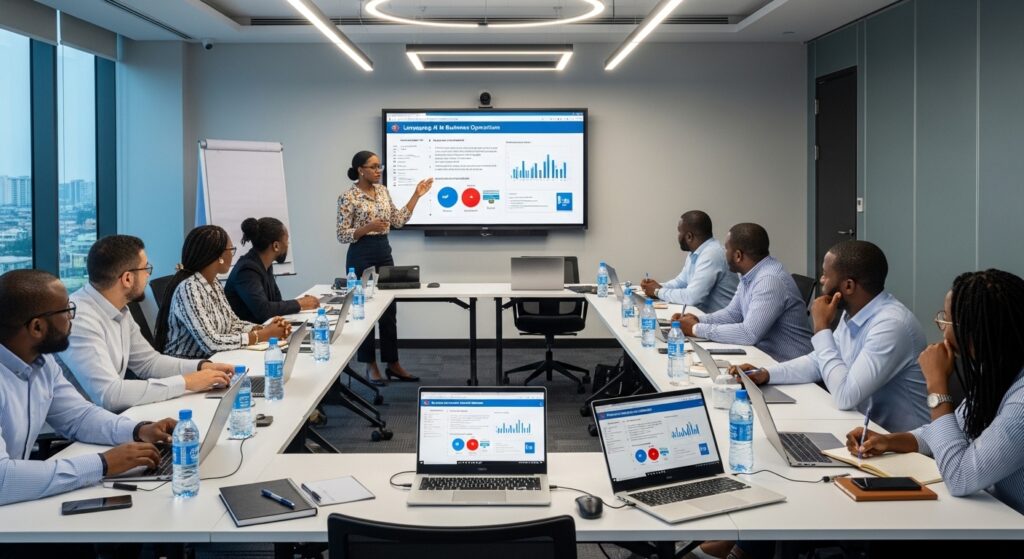
In the Lagos business ecosystem, AI adoption has transitioned from a “forward-thinking trend” to a non-negotiable competitive requirement. As of early 2026, 93% of Nigerian companies have integrated AI specifically to drive operational efficiency.
The divide is no longer between those who know about AI and those who don’t; it is between organisations that use AI as a simple chatbot and those that have integrated it into their core digital infrastructure. For Lagosian firms, the challenge is shifting from awareness to industrial-scale implementation.
The Business Reality: The Hidden Cost of “Manual” Work
Despite the tech boom in areas like Ikeja and Victoria Island, many teams still lose thousands of man-hours to “legacy” workflows. In a high-inflation environment, these inefficiencies are no longer just annoying; they are unsustainable.
Recent studies by the Lagos Business School highlight that GenAI is democratising technology by removing the need for specialised coding expertise, allowing non-technical staff to handle:
- Automated Financial Reporting: Reducing month-end closing cycles from days to hours.
- Hyper-Localized Content: Generating marketing materials that resonate with specific Nigerian demographics in seconds.
- Predictive Data Analysis: Identifying market shifts before they impact the bottom line.
Why Generic Training Fails the Nigerian Context
Many organisations attempt to bridge the gap with generic online courses. However, these often fail because they lack “Lagos context”, they don’t account for local infrastructure constraints, specific market nuances, or the unique regulatory landscape of the Nigerian National AI Strategy.
For training to deliver a return on investment (ROI), it must be applied, not just academic.
What Practical AI Training Looks Like
A 9.5/10 corporate training programme isn’t measured by “completion certificates” but by efficiency gains. Effective training in 2026 focuses on:
- Workflow-First Integration: Mapping AI tools directly onto existing SOPs (Standard Operating Procedures).
- Sovereign Intelligence: Teaching teams how to steward their own data securely within the Nigerian digital framework.
- Agentic Workflows: Moving beyond “prompting” to building AI agents that autonomously handle repetitive cross-departmental tasks.
SkillsVerse: Tailored Corporate AI Training in Lagos
SkillsVerse provides a surgical approach to AI upskilling. Rather than a one-size-fits-all curriculum, the training is reverse-engineered from your business goals.
Whether it’s a One-Day Executive Intensive for leadership or a Multi-Week Transformation Programme for technical teams, the focus remains on immediate implementation.
Explore the SkillsVerse Corporate Solutions
The Strategic Risk of Delay
According to PwC’s 2026 AI Performance Study, 74% of AI’s economic value is being captured by a small group of “front-runners” who have moved past pilot mode. For Lagos organisations, delaying training means:
- Talent Attrition: Top-tier talent is migrating to “AI-first” workplaces where they can work more effectively.
- Operational Bloat: Competitors using AI can offer lower prices and faster delivery by cutting “manual” overhead.
The Long-Term Impact: Growth Over Productivity
The most successful organisations in Lagos aren’t just using AI to “do things faster.” They are using it to reinvent their business models. When your team is no longer bogged down by report generation or data entry, they are free to focus on high-level strategy, customer relationships, and innovation.
Conclusion
AI is not a tool you “add” to your company; it is the new way your company operates. In the heart of Africa’s tech capital, the advantage belongs to those who move the fastest.
Is your team ready to lead, or are they just watching the shift happen?